

Area of any shape or object measures its total size. By finding out the area, we can calculate the size of objects like squares, rectangles, circles, triangles, or any other enclosed figures.
Knowing the area could be very important as it helps you simplify your daily based tasks. For example, if you know the area of your room, you’ll be able to purchase a carpet that fits perfectly in your room.
#1. How To Find The Area Of A Rectangle?
The direct relative measurement of the sides of a rectangle can help you find its area. Although the method is quite simple, the chances of errors are high because improper measurements might not provide you with an exact answer.
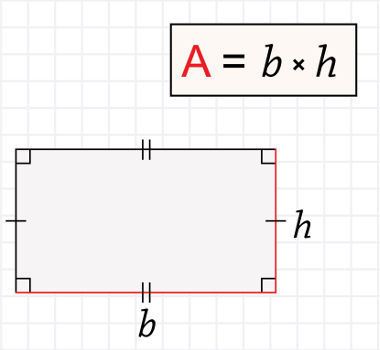
The formula for the area of a rectangle is:
Area = base x height. (Side * side)

(Image Courtesy:tes)
#2. How To Find The Area Of A Rectangle With The Diagonal?
The diagonal of a rectangle is the hypotenuse of the rectangle's width and height. There are various methods used to calculate the area of a rectangle:
1) 3-4-5 Pythagorean Triple Method
To understand this method let’s take a hypothetical example where the diagonal = c^2 and the height and width of the rectangle = a^2 and b^2, respectively.
• Let the diagonal = 225, and its square = 60,025;
• According to Pythagorean Triple is 3-4-5, the hypotenuse is equal to 5, so now we need to figure out the other sides with the given information.
• Since 3 and 4 are close to each other, try a number between 3^2 and 4^2, such as 12.5 and variable x to the 4th power. Also try 6. 6^4 * 12.5 = 16,228.512, but its low. The answer is going to be =(3*x^2)^2+(4*x^2)^2, or 3^2x^4 +4^2x^4.
• Now try putting 7 because 60,025/5^2=7^4=2401: 7^4 *9 + 7^4 *16 = 60,025 which equals to the square of the diagonal! Therefore, 3^2 = 9 and 4^2 = 16 and x^4 = 7^4.
• Note that the shorter side is sqrt(3* 7^2)^2 = 147, and the longer side is sqrt(4 * 7^2)^2 = 196. 147^2 + 196^2 = 60,025 = c^2 which makes the square root to be 225, which is the diagonal.
• Finally, assume that the area of the rectangle then is 196 * 147 = 28,812
This method is successful because many Pythagorean Triples are related to the 3-4-5 triple, but not all of them.

(Image Courtesy:jwilson.coe.uga.edu)
2) Direct Proportional Adjustment
Example: If you are given c = 7.5,
• Then divide 7.5/5 to come down to 1.5
• Now multiply 4*1.5 to arrive at b = 6 and
• Again multiply 3* 1.5 to get a = 4.5; 4.5^2 + 6^2 = 56.25 and c=7.5^2 = 56.25 also,
• So now, side a= 4.5 and side b = 6 and the area = 4.5* 6 which is 27 square units.
(Image Courtesy:alunosonline.uol.com.br)
3) Cartesian Graph Approach
Cartesian Graph approach is a very reliable method to calculate the area of a rectangle. Let’s try to understand the method by taking an example.
• Draw the diagonal hypotenuse starting from point {0, 0} using a scale or a ruler (you can allow for approximation if required).
• Let the length of the diagonal be 7.2 units; then its slope will depend on a and b of a^2 + b^2 = (7.2)^2 = 51.84, which makes a and b to be 5 and 5. 18 if the rectangle is close to a square.
• This makes the slope m = (y2-y1) / (x2-x1) = (5.18-0)/ (5-0) = 5.18/5 = 1.036.
• Draw the immediate rectangle with clear and straight lines.
• Now, 5^2 + 5.18^2 = 51.8324 while 7.2^2 = 51.84 which is pretty close.
• Check for problems concerning tolerance/accuracy/exactitude required.
• Finally, you have the answer. The area of the rectangle is 5 * 5.18 = 25.9
Did you find the article useful? Let us know in the comment section below.
(Featured Image Courtesy: Tech Crash)

41 Opinions

10 Opinions

8 Opinions


