

You must have heard about a MAP sensor while at the mechanic’s shop or probably through a salesperson detailing about a new car! But did you know what does a MAP sensor do or what exactly is a MAP sensor?
Here's a short MAP Sensor guide for better understanding!
Manifold Absolute Pressure (MAP) Sensor is the one that converts engine vacuum force into an electrical signal for identifying the load under which the engine works. This data eventually becomes a basis for calculating the fuel delivery along with timing control. It's ideally located in the air cleaner or just under the dash.
Fuel injected engines are the ones that make use of MAP sensors which instantly provide the information to the ECU (electronic control unit). Alternatively, MAF (Mass Air Flow) sensors can also be used for detecting airflow intake.
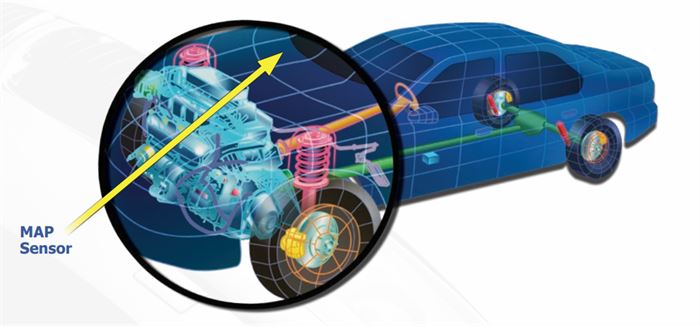
(Image Courtesy: Standard Brand)
MAP sensor basically measures the air pressure in your intake manifold. A machine determines the engine’s fuel and air ratio. And the measurement bar comes set on "0" from the factory itself. But, turbocharged sensors come from with the bar set on 3 or 3.5 horsepower.
For your basic knowledge, Measurement for Pressure is Bar. One bar equals to one atmospheric pressure which is around 14.7 Pounds per Square Inches (PSI). Pressure absence is measured in Inches of Mercury. N/A or Naturally Aspirated is without supercharging, and Forced Induction is with turbocharging. Boost is automation slang for PSI.
A MAP sensor considers the following before accumulating any data:

(Image Courtesy: Your Mechanic)
Uses of a MAP Sensor
Therefore, one should actually invest a substantial amount of time in deciding the right MAP sensor.

(Image Courtesy: Holley)
Malfunctioning
MAP sensor encounters failures due to the high under hood heat and constantly moving wiper arms. So, you can always test the voltage outside the usual range or compare the calculated values with PCM for gaining an insight of the performance deterioration.

(Image Courtesy: Blogspot)
Liked what you just read? Let us know through the comment section below. We would love to hear from you!

76 Opinions

25 Opinions

33 Opinions

98 Opinions

9 Opinions


