
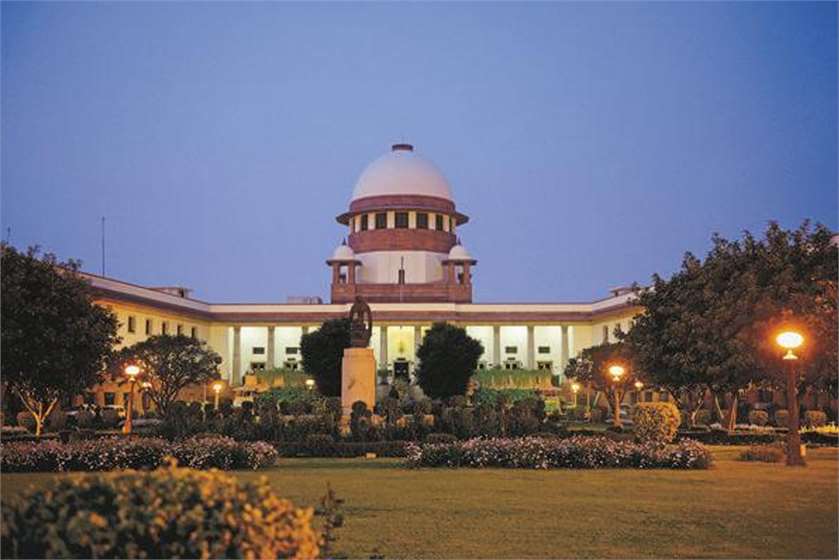
The Supreme Court of India ruled that right to privacy is a basic fundamental right for every Indian citizen.
The apex court, led by a 9 judge bench argued that right to privacy has to be a fundamental right because it is intrinsic to the Right of Life and Personal Liberty according to Article 21 of the Indian Constitution.
This landmark decision is going to change a few things going forward. Most prominently, India’s Aadhar act will come under scrutiny as to where it stands in the grand scheme of the right to privacy, given that it requires an individual to reveal personal biometric data.
This decision will be seen as a landmark moment in Indian judiciary, and the outcome that it produced, is going to affect the lives of 134 crore Indians. Furthermore, it is also a major setback for the Modi government’s push towards the Aadhar act.
Recommend: Do You Think Right to Clean Air Should Be Part of Fundamental Right?
The people of India are rejoicing as their pleas have been heard by India’s apex court. Needless to say, it is a victory for the citizen. However, why has been the right to privacy such a big issue after all?
Privacy helps in ensuring the dignity of a citizen, and that is the reason it has to be a fundamental aspect of the Constitution. There have been several incidents in the past when Article 21 was misinterpreted, and people had to face the brunt of it. The most prominent of them was Kharak Singh’s case in 1992. After being released from jail, Singh was constantly troubled by the police, and policemen shouted names while standing in front of his house.
Then there have been all the problems with Aadhar cards and their credibility. In the past, the Aadhar details of several people have been leaked online, and this posed a major threat to their privacy.
After the Supreme Court’s unanimous decision to uphold the right to privacy as a basic fundamental right, all of India rejoiced the glorious moment. People took to twitter to make others understand as to why India needs to see privacy as a fundamental right was a long-time coming.
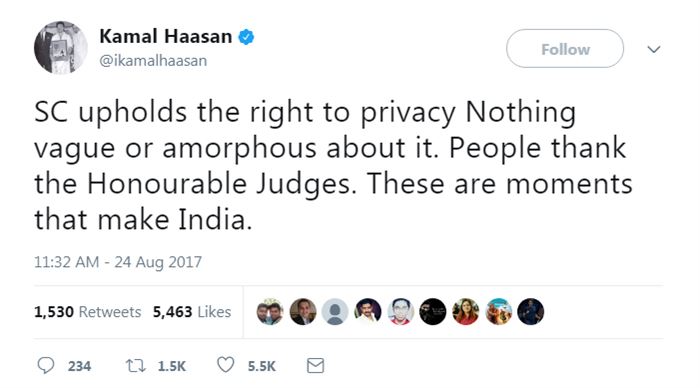
(Image Courtesy: Twitter)
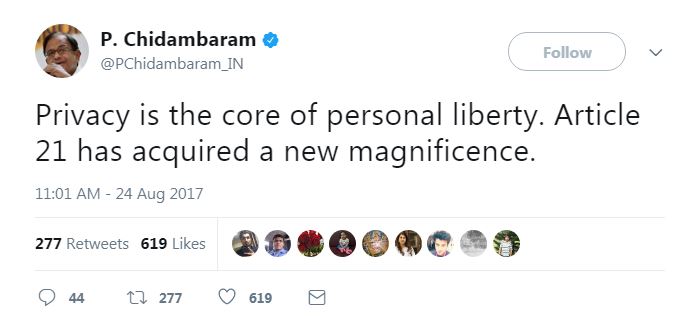
(Image Courtesy: Twitter)
In fact, a major reason behind the apex court to set up a nine judge bench to discuss the issue of a right to privacy was because the court understood that people’s privacy and identity was not being kept safe with the state. Although the NDA government has argued that the Aadhar Act will make it easier for courts to implement its welfare schemes, the nine judge bench conferred that welfare shouldn’t come at the cost of privacy being diluted.
Additionally, there had been proposals by the Modi government to implement a new DNA bill, but the Supreme Court has made it clear that it won’t pass a law if it in any way curtails people of their right to privacy.
In this decision, the apex court has made one huge statement, and that being a man’s house is his castle. In direct relation to the Kharak Singh case, the court identifies that privacy has to be a fundamental right.
This decision in particular changes a lot of things going forward. The court will soon be discussing the validity of Aadhar cards and if they allow citizens to enjoy their right to privacy. With cyber crimes on a surge and instances of people’s Aadhar details being leaked, the court can even render Aadhar as unconstitutional if it feels that it contradicts right to privacy.
In fact, it is not just about Aadhar. As India pushes towards a digital future, privacy becomes a core issue for its government. Right to privacy has to be a fundamental right as it protects India’s citizens from any possible breach in their private lives. In short, this is a victory of the citizen.
What do you think about the right to privacy? Do you believe that right to privacy should be a fundamental right? Let us know in the comments below.
(Featured Image Courtesy: Livemint)

26 Opinions

4 Opinions

27 Opinions

27 Opinions

 Share
Share


I'm just curious whom to blame & praise for #RightToPrivacy
Man peeing on road or serial stalker stalking into our personal life
India is shifting gears and moving towards a digital age. In such times, the need for every citizen's privacy should be of utmost importance for the nation. Landmark day in India's judiciary and surely good things lie ahead.