
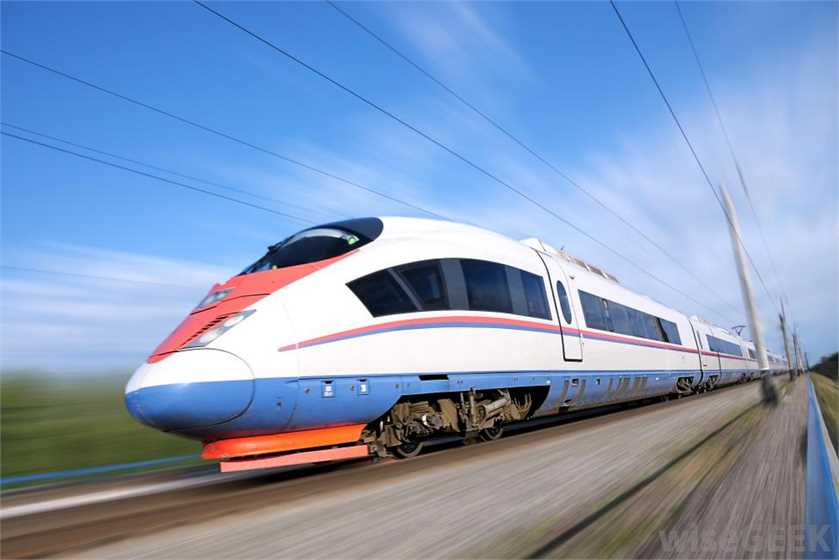
Bullet train is known as the maglev train. It operates with magnetic technology developed by Japanese and German engineers. Japanese engineers talk of with their technique as electrodynamics suspension whereas German engineers talk of with their technique as attraction suspension.
Magnets raise the trains over the track, which suggests there is no need for wheels primarily, attraction suspension operates through the attraction. Bullet trains unit outfitted with electromagnets on their undercarriages. The track, meanwhile, is given coils. associate electrical current equipped to the electromagnets and monitored by computers constantly changes the polarity of the coils, that allows the magnetic fields system to push and pull the train on the track.

Electrodynamic suspension operates with repulsion magnets. Through this method, the technology force keeps the train throughout a stable position by leveling its weight. this method works with attraction coils on the track and super-cooled superconducting magnets on the train cars. once the trains approach the coils, a current is generated. This current permits the train to levitate roughly one in. over the track and center itself.
Bullet trains unit capable of speeds of 300 miles per hour or heaps of. each train carries battery power give that operators can act at intervals the event of associate degree influence outage to prevent a pointy stop in levitation that results in a crash.
People with pacemakers unit told to avoid riding on bullet trains as a result of the magnetic fields have the potential to interfere with the medical devices.
According to MythBusters, bullets from high-powered guns disintegrate in not up to three feet underwater. Slower bullets, as well as those from pistols, travel for regarding eight feet underwater. Bullets pink-slipped at associate degree angle stop underwater at shorter ranges than those pink-slipped vertically into water. Water is denser than air, creating it tougher for objects to maneuver. Forces that lead to forwarding movement area unit called thrust. Drag slows movement by propulsion against thrust. once thrust is bigger than drag, forward movement results. In water, drag is bigger than in air, leading to the additional problem with forwarding movement. The movement of currents in water additionally affects the power of objects and animals to maneuver underwater.
The distance a bullet travels through water depends on the form and initial rate of the spherical. Generally, the quicker a spherical is moving, the less distance it travels underwater. Likewise, blunt-tip bullets retain additional rate underwater than their printed counterparts.
Pointed-tip rounds with a velocity of one,000 feet per second travel between a pair of and fifteen feet, though they're slowed enough that they're non-fatal on the far side three feet. Similarly, pointed-tip rounds pink-slipped at a pair of,500, 2,800 or 3,000 feet per second can fragment within the initial 3 feet, therefore having a negligible travel distance. Blunt-tip rounds with a velocity between 900 and a couple of,000 feet per second will travel up to eight feet and still be fatal on the far side that they're slowed.

 Share
Share


