
Science is a fascinating subject and those of you who have studied
the human body and cell structure would know how complex the inner
system is. These tiny little cells make up our entire body and are
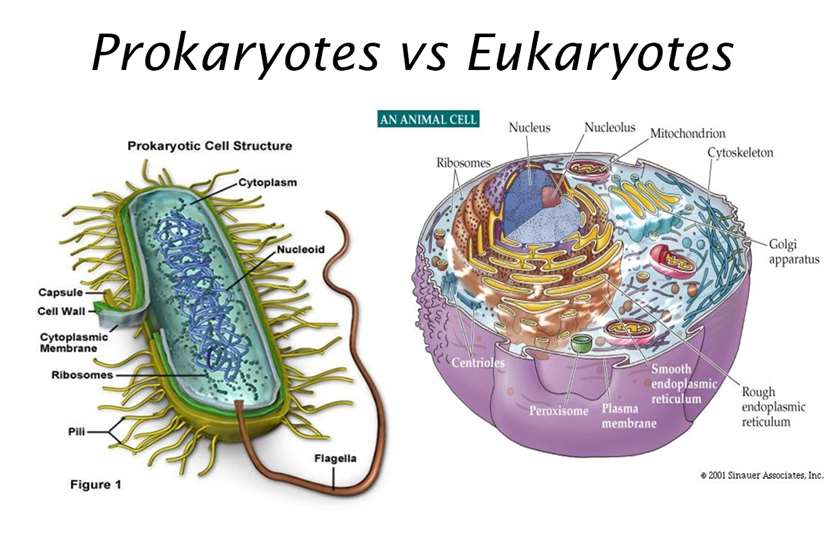
broadly classified into Prokaryotic cells and Eukaryotic cells.
This division is made based on the fact that their genetic material enclosed by a nuclear cover or not.
Prokaryotic Cells
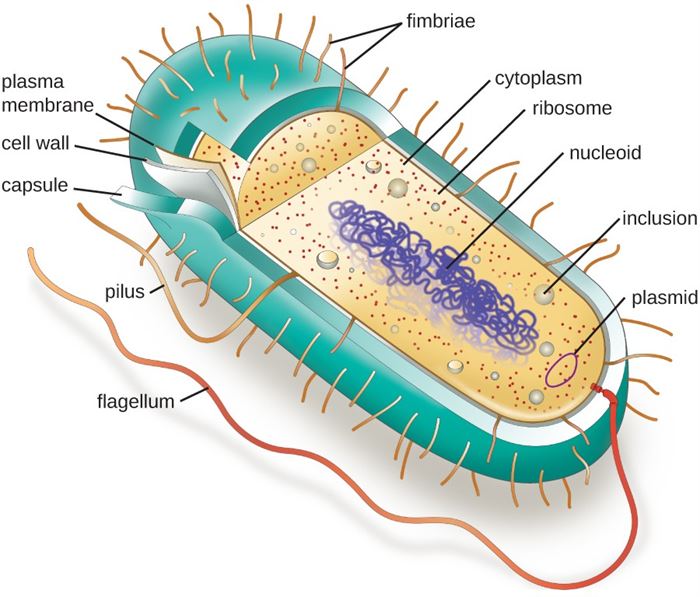
Prokaryotic can be broken down into two words: pro means primitive, and karyon means nucleus. The name given in itself denotes that they are the most primitive cells, which is the case from a purely morphological point of view. The chromatin bodies of these cells remain scattered inside the cytoplasm, and they do not have a definite nucleus. Such nucleus that does not have a nuclear membrane is called a nucleoid. One very well known example of this is the blue, green algae.
(Image Courtesy: Lumenlearning)
Eukaryotic Cells
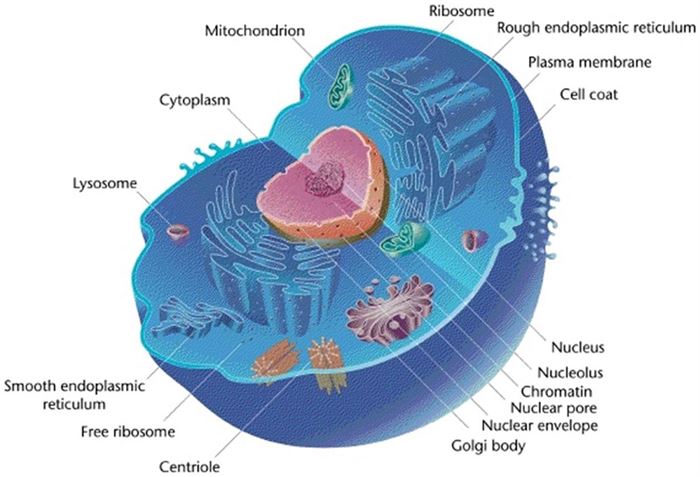
These cells are believed to have evolved from the aforementioned cells which are prokaryotic cells. Eukaryotic cells contain a definite nucleus, and unlike prokaryotic their chromatin bodies are covered by a nuclear membrane. These cells are larger in size as compared to prokaryotes and have a better structural organization. Their functional efficiency is also better than that of prokaryotes.
(Image Courtesy: Biology Dictionary)
The difference between prokaryotic cells and eukaryotic cells
#1. The size of a eukaryotic cell is 0.1-5.0 um whereas the size of a prokaryotic cell is 5-100 um.
#2. The eukaryotic cell has more than one number of chromosomes while a prokaryotic cell has just one but it's not a true chromosome, rather plasmids.
#3. Eukaryotic cells are usually multi-cellular whereas prokaryotic cells are generally unicellular though there is an exception in the form of some cyanobacteria may be multicellular.
#4. Eukaryotic cells are found in plants and animals whereas prokaryotic cells are only found in bacteria and archaea
#5. In a eukaryotic cell, the DNA is commonly linear while in a prokaryotic cell the DNA is circular.

(Image Courtesy: ThingLink)
#6. Sexual reproduction is present in eukaryotic cells but is completely absent from prokaryotic cells.
#7.
Cell wall if present in eukaryotic cells contain cellulose while
peptidoglycan is completely absent such as in the case of plant cell
wall whereas, in the case of prokaryotic cells, peptidoglycan is present
along with mucopeptide in the cell wall.
#8. In a eukaryotic cell, plasmids are rare whereas in prokaryotic cell plasmids may occur.
#9. A prokaryotic cell membrane may have an infolding called mesosome which is completely absent in a eukaryotic cell membrane.
#10. In a eukaryotic cell, a distinction of interphase and mitotic phase occurs during the division of cells whereas in prokaryotic cells there is absolutely no visible division of interphase and mitotic phase.
#11. The flagella
is a simple structure in prokaryotic cells composed of protein and
flagellin whereas in a eukaryotic cell they are complex with
Astounding
isn't it that a little cell in the body is loaded with so many things
and are different in a variety of ways. For more science, related and
other questions do drop us a message in the comment box below.
(Featured Image Courtesy: Quora)


