
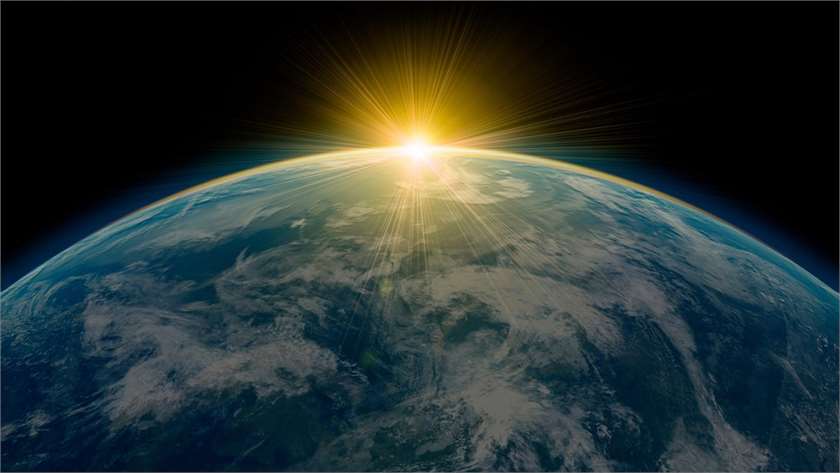
Every year two times the position of the sun does not change direction at a given time of a day and it comes to a halt. These two times are the longest and the shortest days of the year. These two days of the year, which have the maximum and minimum daylight hours, are referred to as solstice.
Solstice is a Latin word in which "sol" means sun and "sistis" means "stands still". So when the sun stands still it is referred to as solstice.
There are two solstices:
1. Summer solstice.
2. Winter solstice.
The summer solstice occurs on June 20-22, which has the longest daylight time and shortest night time and the sun is directly overhead at noon on the Tropic of Cancer at latitude 23.5 degrees North with the Earth's North pole at its maximum tilt towards the sun.
The winter solstice happens on December 21-22, which has the shortest daylight time and longest nighttime and the sun is directly overhead at noon on the Tropic of Capricorn at latitude 23.5 degrees South with the Earth's South pole at its maximum tilt towards the sun. The summer solstice is the first day of summer and the winter solstice is the beginning of the winter season.
This holds good for the northern hemisphere, which includes Asia, Africa, Europe, Northern America, and Central America.
In the southern hemisphere, it is vice versa, which includes Southern Africa, South America, Australia, and New Zealand. The summer solstice happens on December 21-22 and the winter solstice on June 21-22. So when it is summer in the North America, it will be winter in the South America and in the same way when it is winter in North of the equator, it would be summer in the South.
Why is it that it is opposite seasons in the north and south hemisphere?
That is because the two hemispheres actually are in the opposite directions in the planetary pole. As the earth moves around the sun, the hemisphere that face towards the sun will experience summer and the hemisphere that is away from the sun will have winter as the season. In another six months' time, due to the earth's rotation around the sun, the hemisphere that experienced winter will now be facing the sun and as it is nearer to the sun, it will have summer season and in the other hemisphere, it will be winter season.
This year a special occurrence of the strawberry moon happened on the June solstice. Previously it happened in 1967 and it would take another 46 years, say in the year 2062 on June 21st, for this phenomenal occurrence to happen again.
But why is it called the strawberry moon?

That is because of the tribal group named Algonquin tribes in the Northern America, who would gather ripened fruits on that special day. In Europe, it is referred to as the Honeymoon or the Full Rose moon.
The summer solstice in the southern hemisphere will be on December 21, 2016 16:14 Indian time and the summer solstice in the northern hemisphere will be on 21st June, 2017 09:54 IST, which would happen on a Wednesday. It would be vice versa for the winter solstice.
Whereas on Mars, it has a 687-day orbit around the sun, so it experiences summer and winter solstice in a period of 23-month interval. The summer solstice on Mars happened on February 15, 2014, and the winter solstice was on January 3, 2016.
The degree of sunlight that is experienced during the summer solstice varies with the latitude. In the Northern Arctic circle, even though, the sun circles the sky for 24 hours, due to the low angle of the sun, heating is not very effective and so even in peak summer Arctic area remains cold even though the sun shines for days and months together.
Without sun, there will be no occurrence of the seasons and no life on earth. So let us salute the sun power.


157 Opinions

231 Opinions

 Share
Share


