
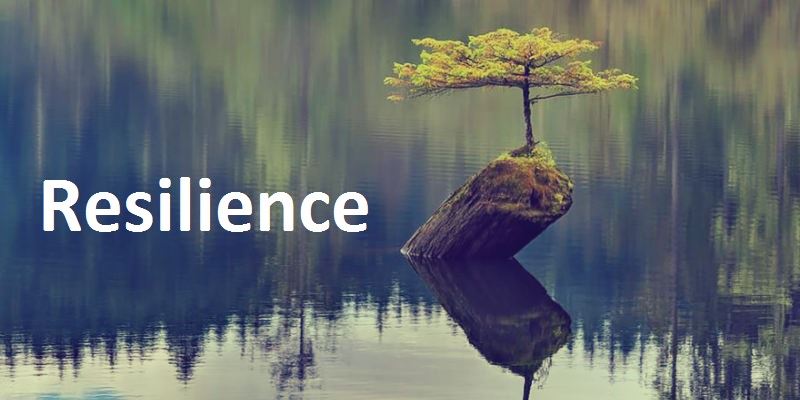
What is resilience? Resilience is nothing but the springy act of rebounding or recoiling. It is the power of coming back to the original shape or size after a compression, pressure, etc.
A classic example of resilience is the atomic bombings by the United States against Japan in the final stages of warfare of World War II on August 6th, 1945. It was said that nothing will grow in Hiroshima for the next 75 years, but to everybody's surprise in just few week's time, a remnant of a tree trunk began to sprout new branches. This is a true symbol of resilience for the ability of life to survive.
 Herbert Spencer coined the phrase “Survival of the fittest”. Who are all fit and unfit? The biggest, strongest and the smartest ones are the fit ones, the winners, and those who are unable to survive are the unfits. Evolutionary fitness refers to the capability of an organism to survive and reproduces in a particular environment.
The quality of being like a spring is referred to as being resilient, which is basically coming back to oneself after a stress or disaster. It is not that the person who goes through the pain or trouble is a strong person. He/she bends and gives way to the trauma. But slowly they accept the calamity and adjust to the surrounding and move on. The ways to build resilience varies from one person to another. Developing the power of resilience is their own personal journey. The people who lack resilient capability recover very slowly and they very easily will go into a psychological distress or depression.
The inborn capability of resilience is due to mutation of the cells during reproduction. There is also another kind of resilience that develops with time as they experience the trauma. It does not mean that there is no grief or sadness involved. They do go through the unfavorable condition with pain and slowly adjust themselves to it.
Some of the factors that contribute to resilience are:
1. Family and friends: After a failure in any attempts, serious illness, or death in the family, etc, support of the family and friends rejuvenate resilience in a person's life.
2. Positive attitude: Being optimistic is a great boost of strength.
3. Management skills: The ability to manage and cope up with themselves.
4. Professional help: Acquiring professional guidance from a specialist.
5. Helping others: Being helpful to somebody who is going through the same trauma.
6. Taking good care of oneself: Nurturing well and not hating oneself. Doing exercises, yoga, meditation, etc. Taking healthy foods.
7. Not getting addicted: By not indulging in substance abuse, alcohol, or cigars etc
8. Becoming a writer: Sharing the experience with others by writing out their feelings.
CLIMATIC RESILIENCE
Apart from human beings, plants and animals, there is climatic resilience too. Global climatic changes have led to increasing the levels of carbon dioxide and greenhouse gasses leading to global warming and climatic instability. This globalization has resulted in the destruction of plants and animals across the planet. Over a thousand scientists researched across the globe and showed that the earth's ecosystem is on the edge of collapsing any time and we have already lost many endangered species. Climatic resilience comes from absorption of the stress and the adaptation of the plants and animals to the climatic change.
Climatic resilience has two components, first, the changes provided by nature and secondly reaction caused by the human action. With the realization of global warming, the awareness has spread worldwide. It is all “Go Green” now with the initialisation of the green revolution.
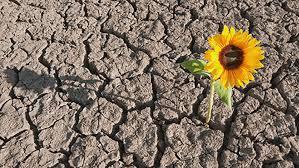 As Nelson Mandela quoted “The greatest glory in living lies not in never falling, but rising after every fall”. It's okay to fall and make mistakes which we have done in plenty and spoiled the ecosystem, but we have now realized the errors and are now controlling the global changes, which is a big step towards a better future.


15 Opinions

9 Opinions

 Share
Share


Everyone has the resilience power, but it is upto the individual on how they use this power.