
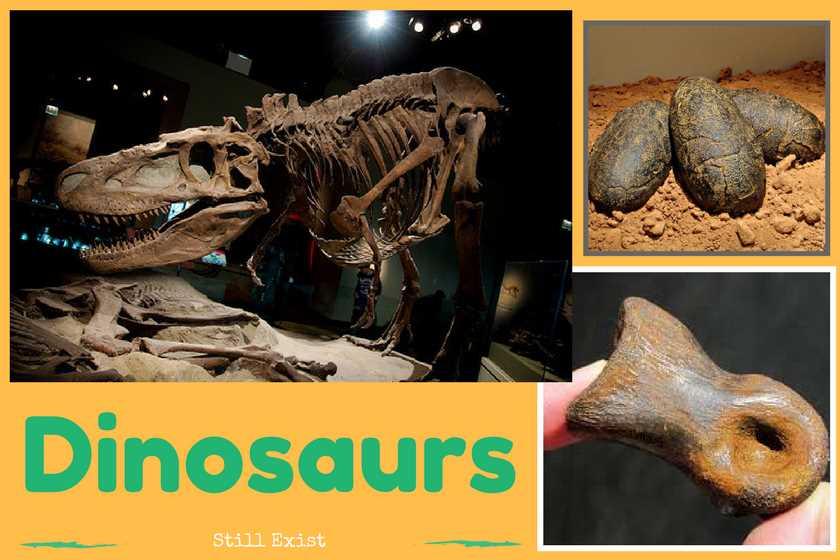
Do dinosaurs still exist?
Dinosaurs have constantly captivated the human curiosity. The possibility of Goliath reptiles is reminiscent of unbelievable depictions of mythical beasts. It might be bizarre to believe that dinosaurs are still alive today, however, strangely, it is not so much sci-fi or urban myth. To locate a genuine, live dinosaur, you should first learn exactly what happened to these captivating animals.
The Theory of Evolution
To comprehend the account of the dinosaurs, you should know a tiny bit about evolution, the scientific explanation for creation of new species. Gradually, over numerous eras, genetic mutations happen in the gene pool of a species. The greater part of these are hurtful and don't survive. Sometimes mutation of a species causes it to change its behavior or shape in a way that is advantageous to its survival. After sufficient mutations, a group of animals may never again be recognizable as belonging to the same species as its predecessors. The fossil record (the remaining parts of creatures embedded in layers of rock) shows cases of species that changed its form in this way over a million years.
After sufficient mutations, a group of animals may never again be recognizable as belonging to the same species as its predecessors. The fossil record (the remaining parts of creatures embedded in layers of rock) shows cases of species that changed its form in this way over a million years.
Dinosaurs
The fossil record shows that dinosaurs rose to dominance 200 million years ago in the Triassic period. From Jurassic to Cretaceous somewhere around 200 and 66 million years back, they were the predominant creatures on earth. Researchers know about dinosaurs presently from fossil records. Depending on how deeper a fossil is embedded in the earth’s crust, researchers can gauge how old it is. Dinosaurs were basically reptiles however with some noteworthy distinguishing factors.
They were warm blooded and had an upright position when contrasted with today's reptiles and other reptiles that were living millions of years ago. Dinosaurs additionally preferred to ambulate on two legs. This is particularly valid for the Theropods, a class of carnivorous predatory dinosaurs including the Velociraptors and the Tyrannosaurus Rex. Theropods, strikingly enough, in some cases had hollow feathers and bones.
They were warm blooded and had an upright position when contrasted with today's reptiles and other reptiles that were living millions of years ago. Dinosaurs additionally preferred to ambulate on two legs. This is particularly valid for the Theropods, a class of carnivorous predatory dinosaurs including the Velociraptors and the Tyrannosaurus Rex. Theropods, strikingly enough, in some cases had hollow feathers and bones.
The Great Extinction
The era of the dinosaurs, obviously, came to a close. Around 66 million years back, something happened known as the Cretaceous-Paleogene extinction. During this period of extinction, most of the major species inhabiting planet Earth were completely exterminated. On the chronological calendar, this happened almost instantly. You can see the impact of the asteroid in fossil records. It shows up as a layer of soil containing a lot of radioactive iridium, which is commonly found in asteroids.
A colossal asteroid impact in the Chicxulub crater in the Gulf of Mexico is believed to have caused the Cretaceous-Paleogene extinction. The humongous asteroid is believed to have spanned several kilometers. The primary impact should have been without a doubt terrifyingly destructive, yet far more harmful were the enormous volumes of dust which blocked sunlight from reaching earth. The food chain was obliterated as plants could not survive. Nearly all of the dinosaurs and numerous other species vanished from fossil records.
You can see the impact of the asteroid in fossil records. It shows up as a layer of soil containing a lot of radioactive iridium, which is commonly found in asteroids. A colossal asteroid impact in the Chicxulub crater in the Gulf of Mexico is believed to have caused the Cretaceous-Paleogene extinction. The humongous asteroid is believed to have spanned several kilometers. The primary impact should have been without a doubt terrifyingly destructive, yet far more harmful were the enormous volumes of dust which blocked sunlight from reaching earth. The food chain was obliterated as plants could not survive. Nearly all of the dinosaurs and numerous other species vanished from fossil records.
The primary impact should have been without a doubt terrifyingly destructive, yet far more harmful were the enormous volumes of dust which blocked sunlight from reaching earth. The food chain was obliterated as plants could not survive. Nearly all of the dinosaurs and numerous other species vanished from fossil records.
Winged creatures
In any case, not all dinosaur species were wiped out by the Cretaceous-Paleogene extinction. A sub-group of feathered smaller theropods managed to survive the destruction. Over the course of millions of years, they had evolved into what are currently known as birds. Physically birds are like dinosaurs and in fossil records, there isn't a clear-cut difference between the early birds and feathered smaller theropods. In the year 2007, a Tyrannosaur skeleton was found with delicate tissue preserved.
Genetic testing demonstrated that the skeleton had similarities to modern bird species than to the reptilian class of animals. Researchers have almost come to a consensus that birds are descendants of dinosaurs. The few who differ contend that birds are rather, descendants of a specific species known as the Archosaurs. "Archosaur" denotes a bigger group that incorporates dinosaurs. As a matter of fact, crocodiles and related species are believed to be descendants of Archosaurs, but not dinosaurs. This implies crocodiles have a more common lineage with birds rather than reptiles.
To summarize it all, there are ample reasons to believe that there are few dinosaurs that are still alive and kicking. Birds are as a matter of fact the sole surviving predecessors of dinosaurs. They are simply not considered as such. Watch through your window at this moment and you may discover a dinosaur flying by.


42 Opinions

13 Opinions

 Share
Share


I dont think that dinosaurs still exist.