

Small is beautiful, small is better. This seems to be the line that best explains the push in modern smartphone technology.
Manufacturers are continuously pushing their smartphones to be extremely compact. While the phones themselves sport huge screens, the internal components are continually being trimmed down in order to make the devices sleek.
To fend for a compact smartphone, manufacturers have introduced a new nano-SIM tray. Gone are the days when we used to insert large SIM cards in our phones. SIM cards have been shrunk down to the size of a fingernail, and that has allowed manufacturers to save a lot of space to put other internal components. We take a look at how you can convert your micro-SIM into a nano-SIM.
How To Cut Your Micro-SIM To Nano-SIM?
To begin with, it is, in fact, possible to cut your SIM card, right at your place. You don’t need to go to a mobile shop to cut your SIM. All you need is a frame and a pair of sharp scissors. Following are the steps in which you can cut your SIM card without a SIM card cutter.
#1. You first need to download and print a cutting template. While you can cut your SIM card without a template, it increases the risk of damaging your SIM card. So, we’d suggest you print a cutting template.
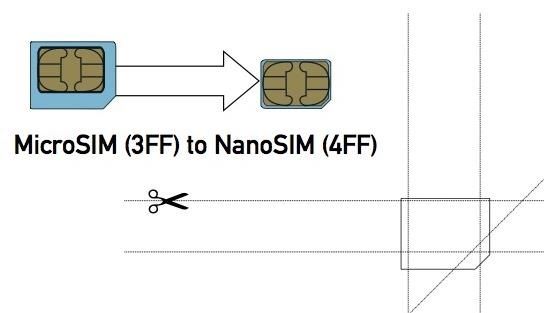
(Image Courtesy: TechnoBuffalo)
#2. Once you have the template handy, place your SIM card on the space in the template, and simply trace the lines along which you have to cut your SIM card using a pen or a pencil. It might look at first that you’re cutting the chip of the SIM, but don’t worry as the chip of SIM is a tiny square and won’t be affected if you draw the lines precisely.
#3. Once you have got the traced lines on your micro-SIM, it’s finally time to cut it down to a nano-SIM. To do that, you can either use a sharp pair of scissors or a cutter. We recommend the scissor because it makes the cutting more precise, thereby reducing the risk of damaging your SIM.
#4. Once you’ve cut your micro-SIM along the lines, you’ll get your nano-SIM card. However, we’d suggest you rub the SIM card against a sand paper to round off the rough edges. If you don’t have sandpaper at your disposal, you can even use your fingernails.
A nano-SIM has a lot of applications. Most of the new smartphones in the market today require a nano-SIM. In case you ever want to convert your nano-SIM back into a micro-SIM in the future, you can use adapters that are readily available in the market. Don’t forget to let us know of your SIM cutting adventures in the comments below and good luck!
(Featured Image Courtesy: Otkuptelephona)

12 Opinions


