

A major question that troubles many aspiring developers is- ‘are Java and JavaScript similar?’ With their similar object oriented programming and a similar utility in front and back end development, many go on to compare Java and JavaScript and consider them to be a part of the same platform. However, the fact that the word Java is used in both does not imply any substantial similarities between the two. In fact, Java and JavaScript have an entirely different origin and applications.
In order to help you understand the concept, and the two languages better, here is the difference between Java and JavaScript.
#1. Virtual Machine vs. Browser
Java, being a compiled programming language is compiled into a bytecode and then run on a virtual machine. JavaScript, on the other hand, has an interpretation based approach and can be easily supported on a browser.

(Image Courtesy: Technology)
#2. Static vs. Dynamic
Java employs a static type checking methodology, where the user is required to specify the kind of variable that they create. However, JavaScript employs a more dynamic approach and it is not imperative for the programmer to specify the type of variable that he has created.
#3. Multiple Threads vs. One Thread
Java is best known for putting multiple threads into use to ensure a parallel performance of different tasks. JavaScript, on the contrary, employs just one major thread. This, in turn, makes Java quite faster than JavaScript.

(Image Courtesy: YouTube)
#4. Hierarchy vs. Prototype
Java follows a class-based and hierarchical structure whereby the properties can be defined and inherited by the members of a similar class. JavaScript, on the other hand, uses a prototype to enable inheritance of its properties.
#5. Anonymous Function vs. Anonymous Class
Java does not allow a free closure process. The only way programmers can get a closure is by using the anonymous class. Contrary to this, JavaScript has a rather free approach towards closure and supports it by providing the programmers with the anonymous function feature.

(Image Courtesy: Experience Unlimited)
#6. Programming Language vs. Scripting Language
Another major difference between the two is that of their type. While Java is an object oriented programming language, JavaScript is an object-oriented scripting language. In other words, code structuring is easier in Java as compared to JavaScript.
#7. Byte Code vs. Browser Compatibility
It is easier to run Java as it uses bytecodes to attain independence from other platforms. Well, even though JavaScript can also easily run on a browser, the issue of browser compatibility may hold it down at times. For instance, the codes which run perfectly on Google Chrome may not exhibit compatibility with Mozilla Firefox.

(Image Courtesy: John Resig)
#8. Function vs. Block
When it comes to scoping, the two languages employ an entirely different methodology. While Java uses a block method for the scope of its variable, JavaScript uses a function based method for the same. This means that while using Java, a variable is likely to move out of scope soon after the advent of control external to the block. However, in JavaScript, a variable can be accessed through a function.
#9. Different Extensions
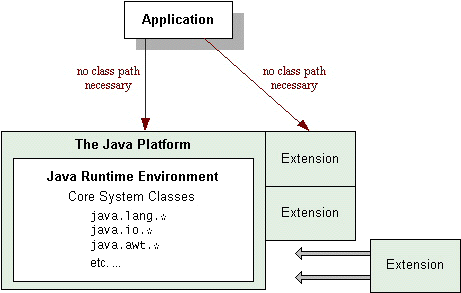
Another one of the differences between Java and JavaScript is that of their extension. While Java uses the file extension of Java while saving the program, JavaScript files are saved with an extension of .js.
(Image Courtesy: YouTube)
#10. Difference In Application
While Java does not have a specific application and can be applied pretty much anywhere, JavaScript is among the three key components of web alongside HTML and CSS. JavaScript is usually applied for web development.
Feel free to drop in more differences between Java and JavaScript. Can you compare Java and JavaScript? Kindly use the comment box to share your thoughts and opinions with us.
(Featured Image Courtesy: YouTube)

 Share
Share


