
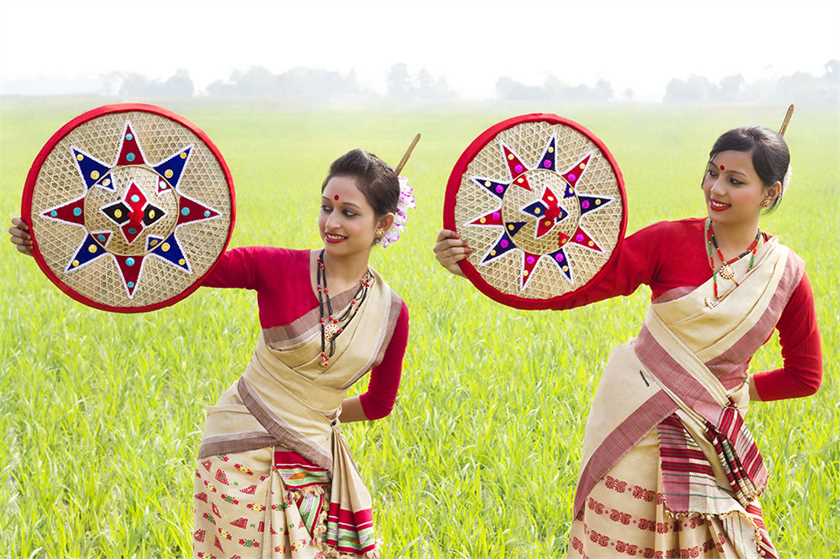
Assam, the second largest state in the northeast India, bears a rich cultural heritage.
People in Assam celebrate many colorful festivals throughout the year because inhabitants of this state are from manifold religions, castes, and tribes.
The different festivals and rituals of Assam express the rich and raw culture of Assamese people. Though most of the festivals in Assam are related to harvesting seasons, there are some festivals which are not related harvesting seasons such as Elephant Festival and Jonbeel Mela.
Elephant Festival of Assam is the largest elephant festival in India. This annual festival is celebrated at Kaziranga National Park in association with Tourism Department and Forest Department of Assam.
Every year, large numbers of tourists visit Kaziranga to partake in the unique festival.
The festival incorporates many elephant activities and cultural programs, making the festival more attractive. It is one of the main tourists’ attractions of the state.
Since 2003, this festival has been organized every year by the Government of Assam.
Initially, 300 elephants attended the festival and health information on 211 elephants was gathered.
However, the toll gradually slumped to 52 and 42 in 2004 and 2005, respectively.
The objectives of Elephant Festival are conservation and safeguard of Asiatic elephants. The festival is also meant to promote eco-tourism among human beings and to grow awareness about the significance of elephants for mankind.
During this festival perfectly groomed elephants are made to move gracefully in procession.
The well-decorated elephants stand in row after row and then they catwalk in front of fascinated audiences.
Elephant races and several games are organized to entertain the guests.
Lots of tourists flock to Assam during this time to enjoy the festival.
The Kaziranga Elephant Festival aims to identify a solution to solve the rising man-elephant conflict.
This unique festival of elephants is carried out with a festive spirit.
The famous Elephant Festival of Kaziranga is observed every year in the month of February between 11th and 17th. The weeklong festival held at the Kaziranga National Park, home to large breeding populations of elephants.
The Jonbeel Mela is one of the most attractive and unique fairs of Assam. It is held every year in Jagiroad, a town located near Guwahati (Assam).
The Jonbeel Mela, which was started several centuries ago, was introduced by Ahom Kings to talk on existing political conditions. The term Jon means moon and Beel mean wetland.
The fair obtained its name from the crescent shaped lake located near the place of fair.
This is the only fair in India where barter system is still practiced. The fair runs for three days and people from plains as well as hills flock to the fair along with their traditional handicraft products and exchange among them according to their needs.
Another important feature of the fair is that it is a symbol of brotherhood and harmony among various communities and tribes.
Before starting the carnival, the organizers of the Jonbeel Mela perform the ‘Agni Puja’ or fire worship for the welfare of human beings. The fair is inaugurated with community fishing that takes place in a crescent-shaped lake.
A large number of people from various communities and tribes, such as Karbi, Jayanti, Tiwa, and Khasi come down to Jagiroad along with wide variety of products, during this fair.
Surrounding the fair a large market is set up where the participants can exchange their products in the barter system.
The barter system is an ancient practice of interchanging of basic essential commodities, which is hardly practiced in the modern society.
During the three days long festival the king of Tiwa Tribe, known as Govaraja, visit the fair to collect taxes from his subjects. The king is accompanied by his attendants.
The people celebrate the festival by taking part in their traditional dances and music.
The three-day long community festival is celebrated in mid-January during the weekend of Magh Bihu.

25 Opinions


 Share
Share


