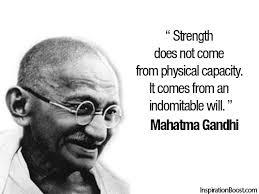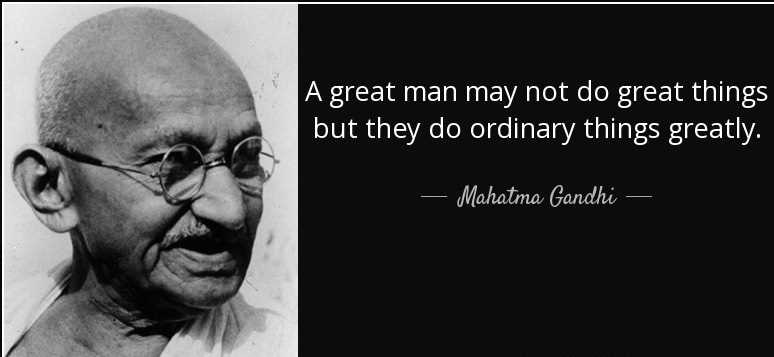
Your ideal of a truly great man: Mahatma Gandhi

2,601 Views Updated: 30 Jan 2018
Follow Post
Your ideal of a truly great man: Mahatma Gandhi

Every human being has his/her own ideal of human greatness. Some venerate the man of clout- the saber-flustering, self-endorsing megalomaniacs – such as Hitler, Che Guevara, and Stalin.

Some seek for inspiration from genius personalities such as Albert Einstein, Rabindranath Tagore, Bob Dillon and Madame Curie.

Many are highly impressed by religious leaders such as Jesus Christ, Ramakrishna Paramahansa, Swami Vivekananda, and Sai Baba.

Even political stalwarts such as Abraham Lincoln, Lenin, Winston Churchill, Nelson Mandela and Indira Gandhi are considered as models by a lot of people.

But my ideal of a great man is something different and more comprehensive than the names stated above. I feel that a great man must be above littleness, paltry spites, covetousness, resentments, and irritations, which is found in most people.  
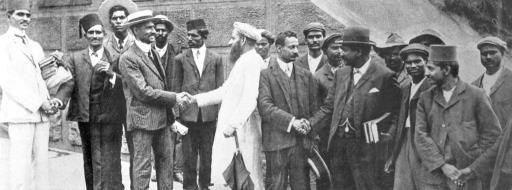

A great man must be dedicated to a noble cause and should be entirely selfless, free from lust and narrowness, truthful in thought and conviction, fearless in action, meek as a lamb, but a lion-heart in spirit.  
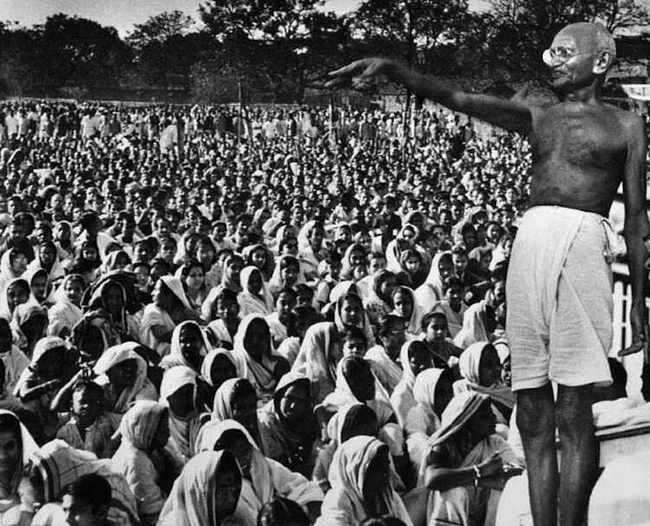
He must be an epitome of humility, appeal to the noblest fundamentals of human nature. He must be a dreamer of visions and a live wire of accomplishments.  

Most of us might say such an ideal is unattainable since nobody is perfect. But we have one Indian who has fulfilled all these qualities and perchance even more. He is Mahatma Gandhi, or Bapu, the Father of the Nation, and I consider him as my ideal of a great man.

Born on October 2, 1869, as Mohandas Karamchand Gandhi, in Porbandar in Gujarat, he led a simple life from early childhood despite enjoying the privilege of being the son of a well-to-do father.  
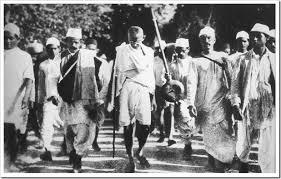
He spent a few years at school and after completing matriculation he went to England to qualify as a barrister much against the wishes of his parents Karamchand Gandhi and Putlibai Gandhi.  

But from the moment that he learned to think independently, he followed the trajectory of truth. He had promised his mother to refrain from non-vegetarian food and wine and during his stay in England, no incitement or temptation could make him break his pledge.  

After returning from England in 1893 he felt that he was not quite at home in the profession of his choice. He moved to South Africa at the invitation of an Indian businessman and there he discovered his true vocation.  

He found the Indian community in South Africa suffering under oppressive and humiliating ignominies, but too meek and scared to resist or raise their voice. He embraced the cause of his countrymen and organized the renowned ‘passive resistance’ based on Tolstoyan values.  
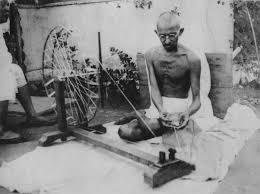
Bapu continued with the non-violent resistance for ten years, suffering physical chastisement and imprisonments and ultimately succeeded in repealing or amending several anti-Indian laws.  

Political scientists doubt whether the Apartheid Policy would have ever existed in South Africa if he had stayed there for a few more years.  

He permanently returned to India in 1914, a few months before the World War I started, and within a few years he became the ‘Face’ of the Congress Party, with a universally admired integrity and irresistible incisive logic. 


Gandhiji salvaged Congress from theoretical abstractions and gave his countrymen the guidance and leadership that was missing in the Freedom Struggle.  

In an age of violence, he opposed the revolutionary actions, preaching and practicing the gospel of non-violence.  

He launched the Non-Cooperation and Civil Disobedience Movements to liberate India from the shackles of Colonial Rule, two non-violent weapons forged in the spirit and hence impregnable.  

Bapu felt the miseries and poverty of his countrymen and literally put on the robe of a beggar to be one amongst them more intimately.  

But no prince or royal persona could match his dignified self-assurance anywhere from the Viceregal Palace in Delhi to the Buckingham Palace in London.  
His speeches were devoid of fiery rhetoric but his articulacy touched even the inmost chords of our mind.  

He did not know the ethereal theories of politics and economics but he did know what the Indians wanted., when he launched the Quit India Movement 

After India attained freedom at the cost of partition on August 15, 1947, the frail and ailing Bapu traveled throughout the country to pacify the Hindu and Muslim rioters and establish peace and goodwill.  

He went to Noakhali in East Pakistan (now in Bangladesh) to soothe the minority Hindu community and then in Patna he was right beside the oppressed Muslims.  

His assassination by a lunatic fanatic in Delhi on January 30, 1948, can only be compared with the crucifixion of Christ.

Mahatma Gandhi is truly a great man if ever there was one! “The Half-Naked Fakir” as termed contemptuously by Winston Churchill.  

In a literal sense Churchill is right, but sooner or later the despise will disperse in the fire of global afflictions, and humanity will comprehend anew the way of Peace, promulgated by Buddha and Christ, which has been trodden with serenity and resolution by Mahatma Gandhi.  

vote-icon.png
Posted by: guptasougata73 Posts: (44) Opinions: (371) Points: 5,170 Rank: 22
0

Related polls