
The Complementary food should consist of foods that are rich in energy, proteins, micronutrients - especially iron, zinc, calcium, vitamin A and folates, should be free from contamination including pathogens, toxins or harmful chemicals, without much salt or spices. It should be easily accepted by the infant, easy to prepare from family foods and at a cost that is acceptable to most families. Children’s ability to chew and swallow foods of various forms, especially foods of thick or solid consistency, varies with age. Infants who are 6 – 11 months of age need soft, mashed (low viscosity) foods, whereas older children can have family foods of solid consistency. By the age of 8 months, infants can start eating some finger foods i.e. foods that can be eaten alone.
The complementary foods fed to the infants include commercial milk substitutes or animal milk, biscuit, cereal preparation or family food. However, cow’s milk is given by most mothers irrespective of their educational status and economic backgrounds. In addition, the freshly cooked family meal is fed to meet the extra nutrient demands of infants after 6 months of age. In India, solid and semi-solid foods prepared at home are the usual sources for the child that includes buttermilk, curds, dal, chapati, rice, khichdi, mashed potato, kheer, porridge, bread, biscuits, boiled egg yolk, banana, pudding, sago, green vegetables, etc.
The guidelines for supplementary foods formulation for older infants and young children is given by the Codex Alimentarius suggests that:
• The dry food should have an energy density of at least 400 kcal / 100 gm.
• An amino acid scores not less than 70 % of casein, and
• Fat content between 20 – 40 % of energy, corresponding to 10-25 gms of fats or oils / 100 gm of dry foods with the level of linoleic acid not < 300 mg / 100kcal or 1.4 gm / 100 g of dry product.
• Apart from the macronutrients, complementary foods should also contain vitamins, minerals and trace elements.
Energy Density
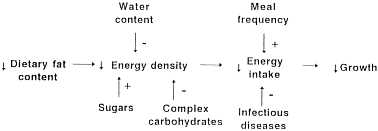
In developing countries, malnutrition is common during the weaning period. One of the reasons is the low energy density of weaning food. Traditional complementary food gruels are based on starchy staple foods that are difficult to consume. To reduce the viscosity of these viscous gruels, water is added, thus reducing their energy density. Hence infants need more amount of foods. Energy density plays a critical role in energy intake.
The energy intake/kg body weight is maintained by increasing the energy density of diet and not by an increase in intake volume. The weaning diet must have an energy density of about 1.0 kcal/g to satisfy the energy requirements.
The energy density of a food is defined as the amount of calories per unit volume or weight of the food. The main factors influencing the extent to which an infant can meet the energy and nutrient requirements are the consistency and energy density of the complementary food, the amount of ingested breast milk and the frequency of feeding.
Positive factors that influence energy density are meal frequency, sugars, energy intake, while negative factors are an intake of complex carbohydrates, infectious diseases, and water content. Other possible factors responsible for low energy intakes among young children in developing countries are categorized into intrinsic or child-related factors, dietary factors, and caregiver behavior. The functional gastric capacity is one of the important aspects of energy intake, which determines the amount of food that can be fed to an infant during one meal.
The stomach capacities of the infants and the amounts of any food stuff they can take in at one time are limited. The capacity of the stomach of the newborn is very small in the first two days of life and increases in volume thereafter. The functional gastric capacity is determined not only by its capacity but also by its rate of emptying. If the energy density of a meal is low, the infant will require a large volume of food to satisfy energy requirements, and this may exceed the infant’s gastric capacity.
A number of complementary foods required by children depend not only on the total energy and nutrient requirements at different ages but also on the nutrients provided by the breastmilk for breastfed children.
Conclusion
Feeding energy dense food provides children with required energy for proper growth and development and also daily requirements will be fulfilled in fewer meals. The amount of food consumed by the children is inversely proportional to the energy density and is directly proportional to the frequency of meals. The energy density of the complementary foods can be increased by following ways: by adding of fat/ ghee in every feed, by adding sugar or jaggery, by decreasing the viscosity. Hence the strategy should be to improve the energy density of complementary foods especially in countries where traditional porridges are of low viscosity and low energy density.


 Share
Share


